- Home
- News
- News items
- HDL MSMW24: The sensor that knows you're still there
HDL MSMW24: The sensor that knows you're still there
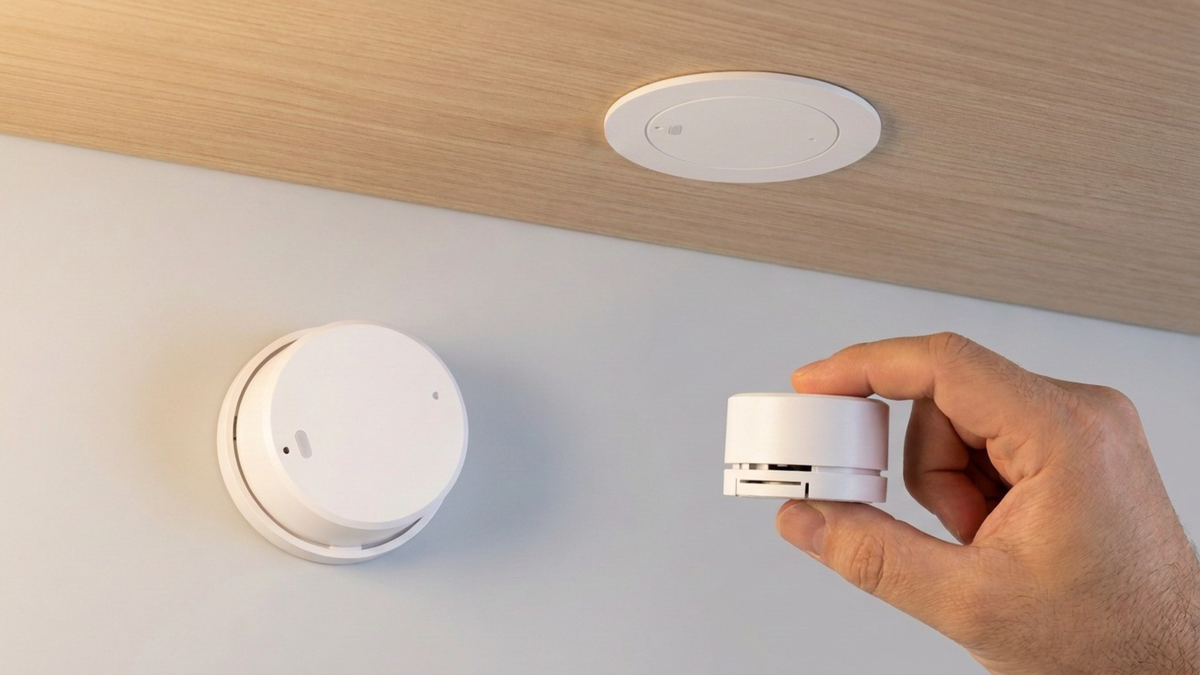
Most occupancy sensors on the market still rely on PIR technology, which means they're really only detecting movement. The moment someone sits still at a desk, reads a book, or falls asleep on the couch, a PIR sensor loses track of them, and the lights or HVAC switch off regardless of whether the room is actually occupied. It's a limitation installers and end users have learned to live with, but it's not a limitation anymore.
The HDL MSMW24 Occupancy Plus Sensor uses 24GHz millimetre wave radar to detect human presence, including micro motion and breathing, so it can tell the difference between an empty room and someone sitting quietly in it. For a KNX ecosystem, that's a meaningful upgrade to how automation responds to the people actually using a space.
Detecting presence, not just movement
The core of the MSMW24 is its millimetre wave radar module paired with HDL's human detection algorithm. Rather than waiting for motion to trigger a response, the sensor continuously reads for the subtle signs of occupancy, breathing and micro movements included, and keeps lighting and climate systems accurately informed about whether a space is in use.
This has a direct impact on two of the most common automation frustrations. Lights no longer switch off on someone working quietly at a desk, and HVAC systems don't run unnecessarily in empty rooms because the sensor knows the difference. It's the kind of improvement that shows up immediately in comfort and just as clearly on an energy bill.
More than a presence sensor
Alongside its radar module, the MSMW24 integrates illumination monitoring, temperature detection, and two dry contact inputs, giving integrators several data points from a single device rather than several separate ones.
The illumination sensor allows lighting to respond to actual ambient light levels, supporting automatic or semi-automatic control and a constant brightness function that adjusts dimming in real time as conditions change. The built-in temperature sensor feeds environmental data straight into the KNX system, and the two dry contact inputs let integrators bring external signals into the sensor's logic engine for additional control conditions.
Speaking of logic, the MSMW24 includes five independent logic modules, each capable of driving up to ten targets. These can combine presence, illuminance, temperature, dry contact status, external messages, and threshold comparisons using AND, OR, or XOR relationships, then trigger switching, dimming, curtain control, alarms, scenes, or sequences. For larger areas, one sensor can also act as a master to up to fifteen slave units, extending detection coverage without adding complexity to the KNX line.
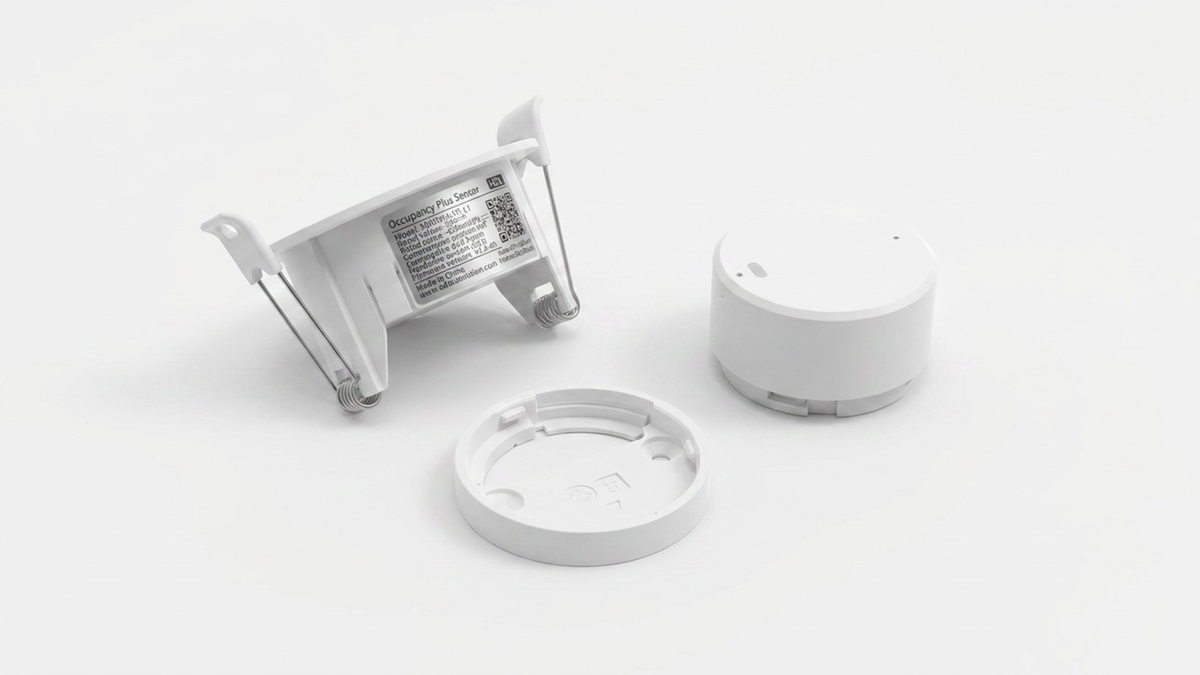
One sensor, flexible installation
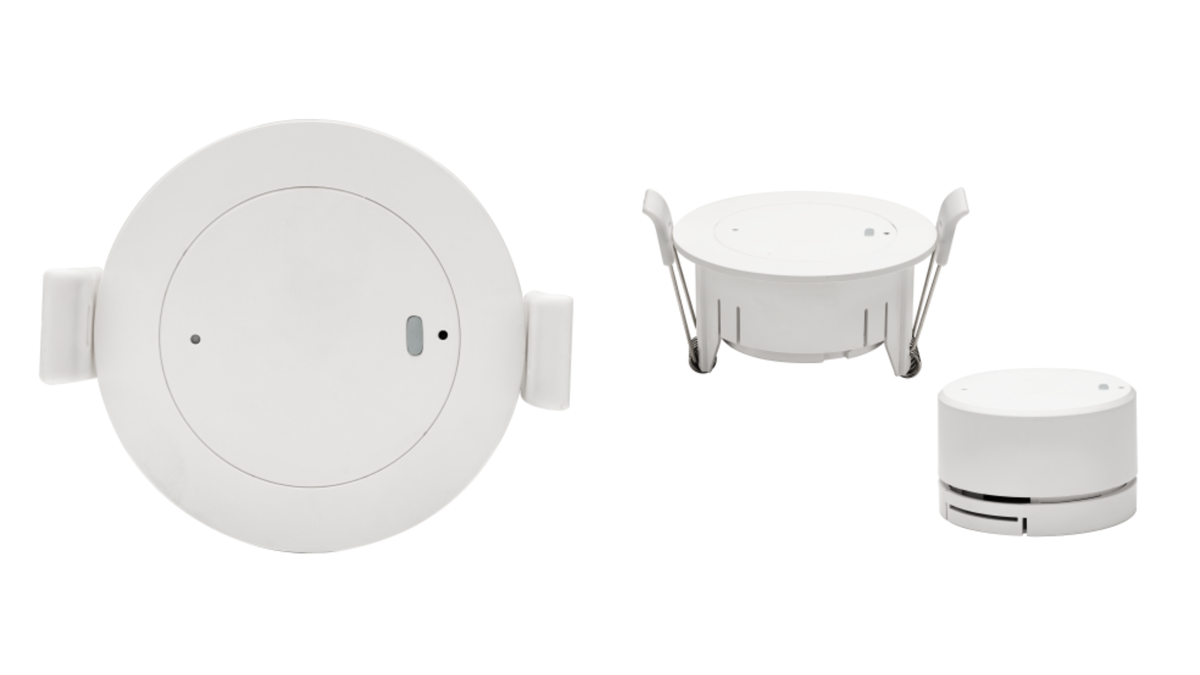
The MSMW24 ships ready for flush mounting via its spring bracket, and converts to surface mounting using the included bottom cap, so the same unit covers both installation styles without needing to stock two separate products. Recommended installation height sits between 2.5 and 3.5 metres, with an adjustable detection radius of 0.5 to 4 metres depending on sensitivity settings.
Specifications at a glance
Rated voltage: 30V DC, input range 21 to 30V DC
Detection frequency: 24 to 24.25GHz
Detection range: 0.5 to 4m radius, adjustable (at 3m installation height)
Illuminance detection: 0 to 1200 Lux
Temperature detection: -20°C to 60°C
Working temperature: -5°C to 45°C
IP rating: IP20
Dry contacts: 2, input only
KNX Data Secure supported
A practical step forward for KNX projects
For integrators working across residential, commercial, hospitality, or healthcare projects, the MSMW24 solves a problem that PIR based sensors were never quite able to close: knowing when a room is genuinely occupied, not just when someone last moved. Combined with its illumination and temperature sensing, flexible logic engine, and dual mounting options, it's a single device that replaces what would otherwise take several separate ones, while giving KNX systems the kind of accurate, real time occupancy data that makes automation feel effortless rather than reactive.